

Data-Driven, Data-Centric, Data Product
Three buzzwords, one widespread confusion

These terms are everywhere - on strategy decks, on job descriptions, in vendor pitches - but clarity around what they actually mean is shockingly rare.
You’re in a meeting and someone boasts that your company is data-driven.
An architect chimes in, championing a more data-centric architecture.
Then a consultant shows up and starts evangelizing data products as the next big thing.
Three terms. Three seemingly progressive mindsets.
And yet, more often than not, they’re used interchangeably, or worse, without any real understanding of their implications.
This is not just a matter of semantics. These terms represent fundamentally different ways of thinking about how data should be used, structured and valued inside an organization. If you're in a leadership role - or even if you're not - you need to understand these distinctions, because they shape the very foundation of how your organization makes decisions, builds systems, and delivers value.
Let’s unpack each one - not just by definition, but by how they work (or fail) in the real world.
Data Driven
At first glance, being data-driven sounds like a no-brainer. Who wouldn’t want to make decisions based on evidence rather than opinion? After all, data-driven organizations are supposed to be more rational, agile and accountable.
And indeed, at its best, being data-driven can:
✔ Improve decision-making by grounding actions in observable patterns rather than gut feeling
✔ Increase transparency, as dashboards and KPIs make it easier to evaluate performance
✔ Encourage a culture of testing and iteration, especially in product and marketing teams
But here’s where the illusion creeps in: many organizations claim to be data-driven when, in fact, they are just data-decorated. They dress decisions in numbers after the fact, or they cherry-pick the metrics that confirm their original biases.
More critically, being data-driven says nothing about how the data is collected, maintained or shared. The underlying systems could be a fragile mess of siloed reports, stitched-together SQL queries, and weekend data hacks held together by hope and Python scripts.
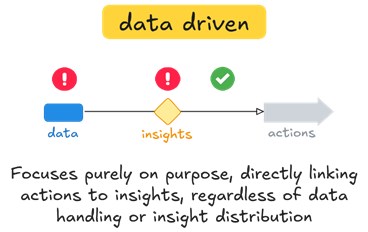
In practice, it often leads to:
❌ Short-termism, where teams optimize for metrics that are easy to measure, not necessarily easy to maintain
❌ Fragile data architectures, built quickly to answer isolated questions but hard to scale
❌ A reactive mindset, where data is used to justify past decisions rather than shape strategic direction
So yes, being data-driven is a step forward from guesswork. But it’s a tactical improvement, not a structural one. It’s a mindset of consumption, not stewardship. And without a serious investment in how data is treated, it can become little more than performance theater.
Data Centric
Where the data-driven approach is about using data, the data-centric philosophy is about organizing around it. It reflects a deeper commitment - not just to analytics, but to data itself as a long-term strategic asset.
This mindset prioritizes data over applications. It acknowledges that while software systems evolve and come and go, the data they produce - when properly structured and preserved - holds enduring value.
In a data-centric organization:
✔ Data is treated as a first-class citizen, not as exhaust from applications
✔ Systems are designed around data flows, rather than bolted onto them after the fact
✔ Governance, lineage and semantics are embedded, not retrofitted
This often leads to better sharing across systems, greater data quality and fewer costly migrations as business needs evolve.
But the data-centric model is deceptively difficult to execute. The desire for centralization - a single source of truth, a master data layer - can easily lead to overengineered solutions and bureaucratic bottlenecks.
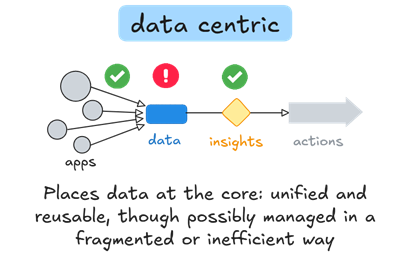
Common pitfalls include:
❌ Over-centralization, where all data must be routed through one monolithic platform, controlled by a single team
❌ Slow response times, as a central data team struggles to keep up with the needs of multiple business units
❌ Rigid schemas and governance models, which can become barriers to innovation and agility
The paradox is that in trying to respect data, organizations sometimes build systems so complex and centralized that they end up defeating the very goal of accessibility and flexibility. They build a beautiful cathedral and then forget how to open the doors.
Data Product
Adopting an approach based on Data Products, requires a shift in how we think about delivering value through data.
Where the data-driven model focuses on usage and the data-centric model on structure, an approach based on delivering data as a product brings in something else entirely: modularity with intent. It borrows from product thinking, applying it to data itself.
A data product is a domain-owned, end-to-end asset that exploits data to serve a specific consumer need. It combines data, metadata, logic and quality controls into a single, reusable unit with a clear interface and defined semantics. Designed for usability and actionability, not just storage, it ensures reliability, ownership, and alignment with business goals.
This approach unlocks the benefits of a data-centric paradigm without falling into the trap of a centralized monolith. Instead, it builds a modular ecosystem of atomic, interoperable components - each focused on a clear purpose, but designed to integrate seamlessly with others. Every new product leverages existing ones, reducing duplication and accelerating delivery, while adding unique value through focused extensions. The result is a scalable, composable data architecture where reuse is not just possible, but built-in by design.
With this approach, organizations gain:
✔ Decentralized ownership, where domain teams are responsible for the data they produce
✔ Scalability, because new data products can be added independently without redesigning the whole system
✔ Built-in accountability, as each product is governed and maintained like any other digital product - with lifecycle, SLAs and feedback loops
This mindset aligns with the principles of data mesh and domain-oriented design. It’s about federation, not centralization. Purposeful interoperability, not one-size-fits-all platforms.
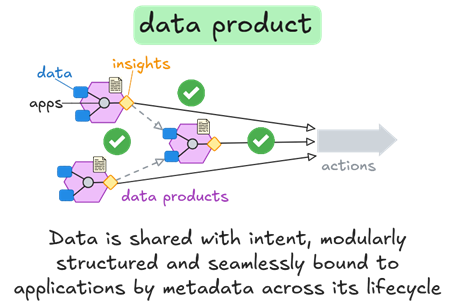
Of course, this model also has its challenges:
❌ Requires cultural change, as teams shift from data producers to data product owners
❌ Needs strong enablement, including platform tooling, governance standards and observability
❌ Demands strategic clarity, to avoid ending up with a proliferation of poorly defined or redundant products
But when done right, this is the only model that truly balances flexibility with quality, autonomy with coherence, local expertise with global interoperability.
It is not a silver bullet, but it is a blueprint for maturity.
Final thoughts
Let’s be clear. These are not stages of a maturity model you pass through automatically. You don’t "level up" from data-driven to data-centric to data product by buying the right tool or reading the right Gartner report.
This is a change in worldview.
Being data-driven is about using data to make decisions
Being data-centric is about structuring systems around data
Building data products is about delivering data as a service - modular, purposeful and owned
Each approach has its place. But too many organizations are stuck in performative data-driven theater, or rigid data-centric overengineering, without ever making the leap to a truly scalable, federated, product-driven model.
Because in the end, the question is not "are we using data?"
It’s: Are we using it well, with intent, and in a way that scales sustainably?
And if not - then it might be time to stop obsessing over buzzwords and start rebuilding your foundations.
Thank you for reading! If you found this article helpful or want to share your thoughts, I’d love to hear from you. It’s a great way to help grow this space and support the work behind it.